A Session With Jeff Owen, VP of Linehaul Operations, at Optym LTL Convergence 2025
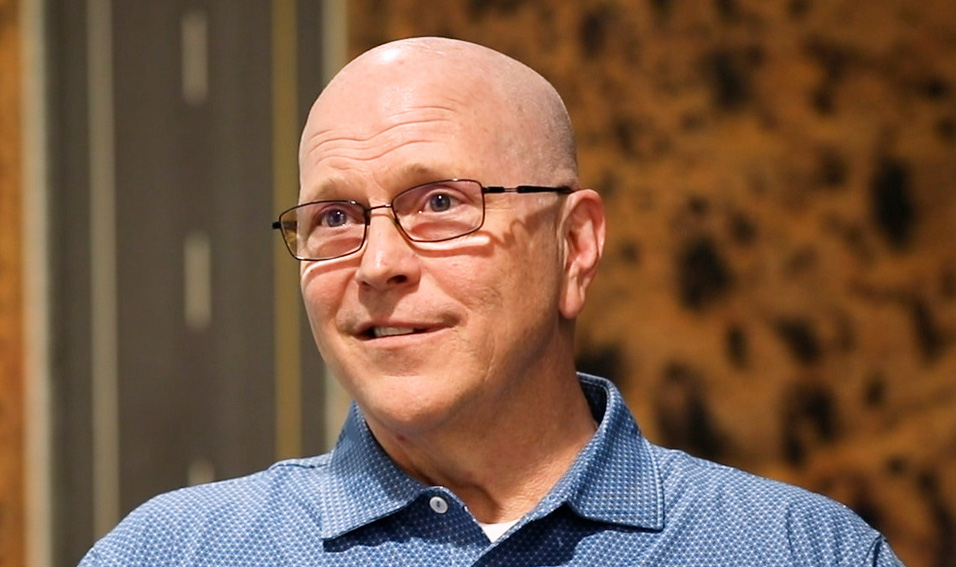
At Optym’s LTL Convergence Conference in November 2025, Jeff Owen, Vice President of Linehaul Operations at Saia, took the stage with humor, humility, and hard-earned experience. What followed kept us listening: a clear-eyed look at how Saia has modernized its linehaul network through optimization and collaboration.
“LTL is a team sport,” Owen said. “Individual commitments to a group effort—that’s what makes a company work.”
For Saia, embracing network optimization has been just that, a company-wide effort that pairs advanced tools with people who know the network best.
From “What-Ifs” to Real Optimization
In the 1990s, linehaul planning was as much art as science. Owen recalls working with Superspin, a tool that helped visualize routes but didn’t optimize them.
“It told you what you thought you were doing,” he joked, “but it didn’t tell you whether it was right.”
Back then, everything depended on tribal network knowledge. Today, optimization and automation have changed that equation. Modern systems analyze real-time capacity, cost, and disruption scenarios in seconds, giving planners the precision and flexibility that once took hours of manual work.
Building Better Plans — and Executing Them Faster
Saia’s optimization journey began with HaulPlan, co-developed with Optym, which turned manual “what-if” analyses into automated, data-driven network planning.
“If you have integration,” Owen explained, “we can change a load plan this morning and be executing it this afternoon. That’s a game changer.”
From there, Saia expanded optimization into a complete planning ecosystem:
- HaulPlan: Automates load planning and includes hub skip and contingency routing for disruptions or weather.
- DriverPlan: Aligns driver schedules and availability to real demand.
- LiveHaul: Optimizes linehaul density, handling, and schedule balance at scale.
As of late 2025, LiveHaul is live in 206 of Saia’s 213 terminals, with full deployment expected by year-end. The tools are intuitive enough that local teams outperform legacy systems within hours of hands-on use.
The Payoff: Fewer Planners, Faster Planning, Stronger Network
Saia’s investment in optimization has delivered measurable gains across its entire linehaul network:
- 5 full-time planners now manage what used to require nearly twice as many.
- Planning time cut by more than 50%.
- 69 new terminals opened in seven years while keeping performance steady.
- Shipments up 30% in the same period.
- Real-time plan execution enables rapid recovery from disruptions.
- Improved density and balance across the network, reducing cost per shipment.
“Controlling linehaul cost is really about density and balance,” Owen said. “Sometimes you have to make your own density — good density is like good cholesterol. You want to keep the right kind.”
By focusing on balance, density, and scheduling rather than just load plans, Saia has unlocked a new level of efficiency and cost control.
Making Optimization Work for People
For all the technology, Owen emphasized that Saia’s progress has been powered by people.
“Optimization tools don’t run the network. People do. The tools just make them faster.”
Every rollout included side-by-side training with terminal teams, ensuring they understood both the how and the why. The approach worked — within one shift, new users could outperform legacy systems and adapt plans on the fly.
“Our planners can beat me with the tool after one shift,” Owen laughed. “That’s how intuitive it is.”
By empowering teams instead of replacing them, Saia turned technology adoption into a shared win and a cultural shift toward data-driven decision-making.
Staying Agile When the Unexpected Hits
When weather, congestion, or competitor disruptions occur, Saia now pivots in real time. Hub skip scenarios, direct loading, and contingency plans can be built in seconds, replacing the “fire drills” of the past.
“In the old days, we’d get everyone in a room and do a fire drill,” Owen said. “Now, we just run a scenario.”
This agility allows Saia to protect service quality even when the network faces unpredictable changes, a vital capability as the company continues to grow.
Lessons from the Linehaul Playbook
Owen closed with five lessons every LTL carrier can apply to their own optimization journey:
- Know your network. Accuracy in data and costs drives better outcomes.
- Integrate systems so plans turn into action. Real-time data means real-time response.
- Focus on density, balance, and schedules. That’s where true cost control lives.
- Empower your people. Tools only work when teams believe in them.
- Always ask the next question. Continuous improvement starts where the obvious answers end.
“Plans are perfect until you pick up a shipment,” Owen said. “Then the world happens. Be proud of your plans but stay ready to adapt.”
Watch the Full Session
Watch Jeff Owen’s full presentation from Optym LTL Convergence 2025.