
In final mile, the plan is never the whole truth.
It may look perfect the night before. Routes are built. Drivers are assigned. Loads are sequenced. Customer windows are balanced.
Then the morning starts.
A driver calls out. A load is not ready. A priority stop gets added. A customer moves an appointment window.
Suddenly, the question is no longer, “Was the plan good?” It is, “How fast can we make a better decision now?”
That is where high-performing final mile teams separate themselves. They do not win because the day never changes. They win because they can absorb change without turning the morning into a fire drill.
The best route plan is executable, not static
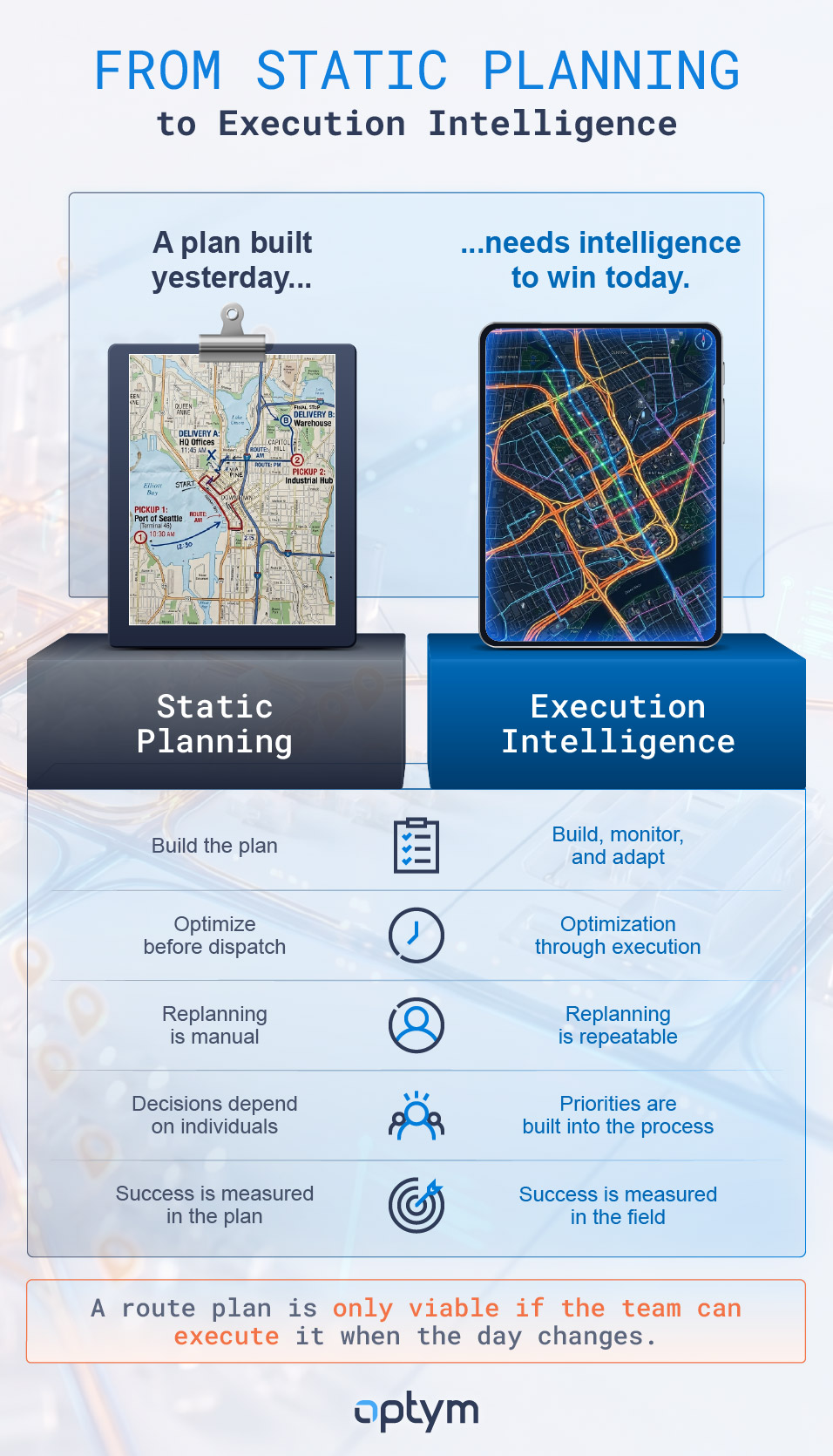
For years, routing has been treated mainly as a planning problem: reduce miles, balance capacity, improve efficiency.
Those things still matter. But in final mile, the bigger advantage is what happens after the plan changes.
A plan that cannot adapt the same day is only half a solution.
The most mature operators are moving from route planning to execution intelligence. They are asking:
- Can we see risk early?
- Can we make the right tradeoff quickly?
- Can we adjust only what needs to change?
- Can we keep drivers, dispatchers, and customers aligned?
- Can we learn from every disruption?
Because planning value is only real if you can execute the changes the same day.
The Re-plan Loop
High-performing teams do not treat replanning as a panic button. They treat it as a repeatable operating loop:
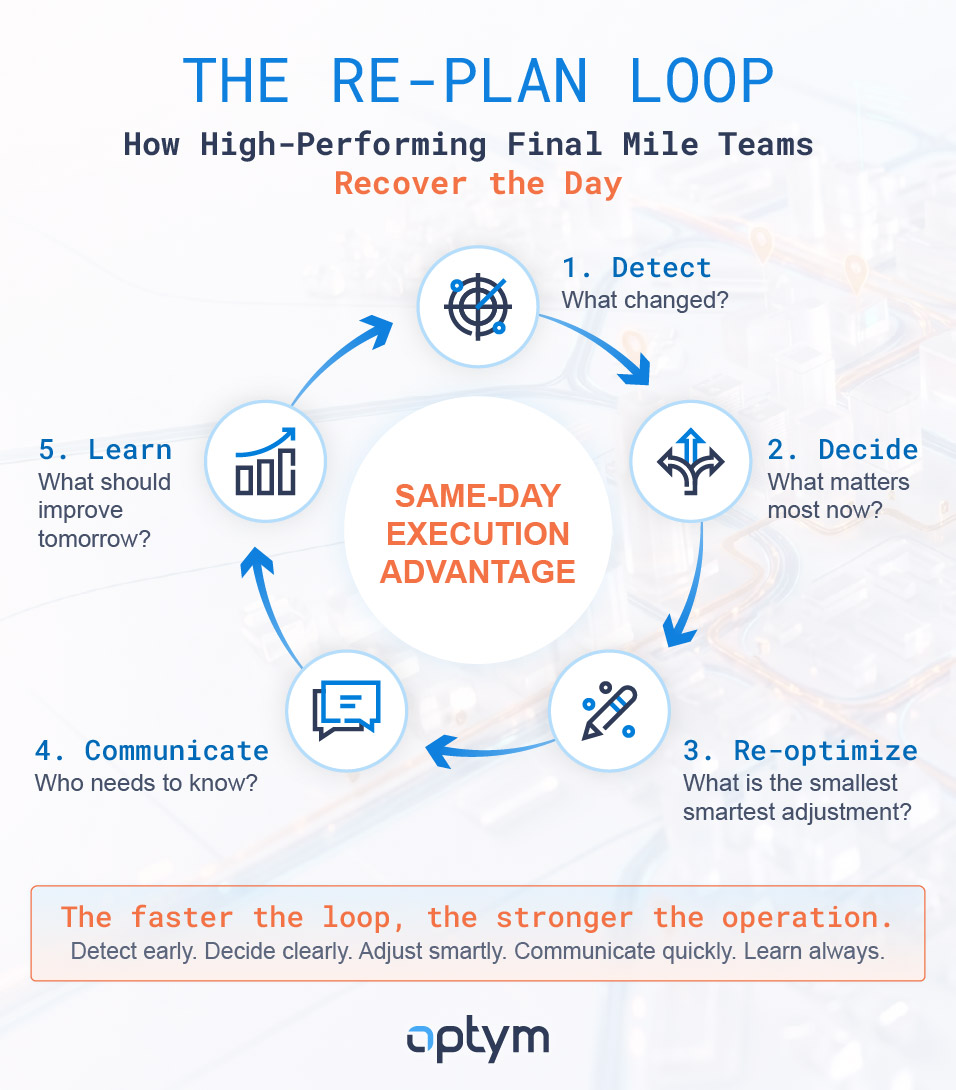
This loop reduces the time between disruption and action. In final mile, that time gap is expensive. It shows up as missed windows, overtime, customer escalations, warehouse confusion, and dispatcher burnout.
1. Detect change early
Many teams do not have a planning problem. They have a detection problem.
They find out too late that a route is at risk, a load is behind, or a customer window has shifted.
Strong teams define the signals that matter:
- Driver availability
- Late loads
- Priority orders
- Appointment changes
- At-risk delivery windows
- Equipment or crew constraints
The goal is not more alerts. It is better operational radar.
2. Decide what to protect
When the morning changes, the hardest question is not, “Can we move the stop?”
It is, “What should we protect?”
Cost? Service? Customer priority? Driver hours? Appointment windows? Route stability?
If every dispatcher, terminal, or region answers differently, the network becomes inconsistent.
The next generation of routing is not just about finding the shortest path. It is about embedding business priorities into daily decisions.
A flexible delivery should not be treated like a must-hit appointment. A regular stop should not be treated like a priority customer. A route with slack should not be treated like one already at risk.
Clear rules create faster decisions.
3. Re-optimize only what needs to change
When the plan breaks, some teams do too little. Others do too much.
They either force the original plan to work, or they rebuild everything and create new disruption.
The best operators take a more disciplined approach:
Change only what needs to change.
If one driver calls out, the whole market may not need to be rebuilt.
If one priority stop appears, a targeted insertion may be enough.
If one appointment window shifts, only one route may need attention.
Fast replanning does not mean constant reshuffling. It means controlled adjustment.
4. Communicate the decision
A replan is not complete when the route changes.
It is complete when the right people know what changed, why it changed, and what to do next.
Drivers need clear updates.
Warehouse teams need the right sequence.
Customer service needs accurate ETAs.
Customers need realistic commitments.
The question is not just, “Did we replan?” It is, “Did the replan move through the operation?”
5. Learn from every change
Every same-day change contains useful information.
A customer who often reschedules.
A building that always takes longer.
A service type that needs more time.
A market that depends too heavily on one dispatcher’s local knowledge.
If that information disappears at the end of the day, the operation repeats the same problems tomorrow.
If it is captured, leaders can improve planning rules, service times, staffing, customer expectations, and local constraints.
That is how execution becomes intelligence.
The leadership takeaway
For executives, replanning is not just a dispatch issue. It is a decision-speed issue.
A final mile network can have strong people and still struggle if decisions depend on manual coordination. It can have good route plans and still fail if the system cannot support same-day execution.
The new advantage in final mile is not simply creating a better plan.
It is creating a faster, smarter execution loop. Because the plan is only the starting point.
The real test comes when the morning changes and the operation still executes with confidence by the afternoon.
-2.jpg)