Every final mile network says it values local knowledge and it should.
Local teams know which buildings are harder than they look, which docks add hidden delay, which customers need special handling, and which drivers can recover a difficult day. In many operations, that knowledge is not a side note to execution. It is the execution.
The problem starts when that knowledge lives only in people.
The moment an operation depends on what a few people “just know,” it becomes harder to scale, harder to improve, and harder to protect. That is where many final mile organizations get stuck. They treat standardization and local expertise as opposing forces.
They are not.
The real challenge is not whether local knowledge matters. It is whether your network is built to keep it.
Hidden knowledge is the risk
Too many final mile operations still run on invisible judgment: the dispatcher who knows which stop always runs long, the planner who knows a route is feasible on paper but risky in practice, the supervisor who knows which crew to send when the service requirement on paper is not the full story.
These are signs of operational strength until they become points of dependency.
When critical knowledge stays informal, the network pays for it in familiar ways:
- Onboarding takes longer than it should
- Performance varies across terminals and teams
- Coverage weakens when key people are out
- Improvement stalls because decision logic is never explicit
What looks like flexibility is often fragility.
Great networks operationalize nuance
The best networks do not erase local judgment. They make it usable at scale.
This is the difference between standardizing tasks and standardizing decisions.
Weak standardization forces uniformity. Strong standardization creates consistency where it matters and flexibility where it is needed.
In most networks, humans are still making too many operational decisions manually. Which route should change? Which exception matters most? Which constraint can flex? Which customer promise must be protected?
Good planners can make good calls. But they cannot evaluate every possible option across thousands of orders, drivers, constraints, commitments, and trade-offs.
Algorithms can. They can enumerate millions of possibilities. Score them. Compare them. Recommend the best decision.
But only if the data is good. That is where human expertise matters most.
The role of planners is not to make every decision by hand. It is to make sure the system has the right inputs: accurate constraints, current service rules, clean operational data, and local nuance captured in a structured way.
This is man-machine cooperation. Humans prepare the reality. Algorithms make the decisions consistently.
That means leaders need to:
- Codify constraints and service rules
- Define repeatable logic for common exceptions
- Capture local nuance as structured input, not side knowledge
- Make decision logic visible enough to refine over time
That is how local expertise becomes part of the operating model instead of staying trapped in workarounds.
The leadership model
At the center of scalable final mile execution is one idea:
Repeatable decisions that reflect real operations
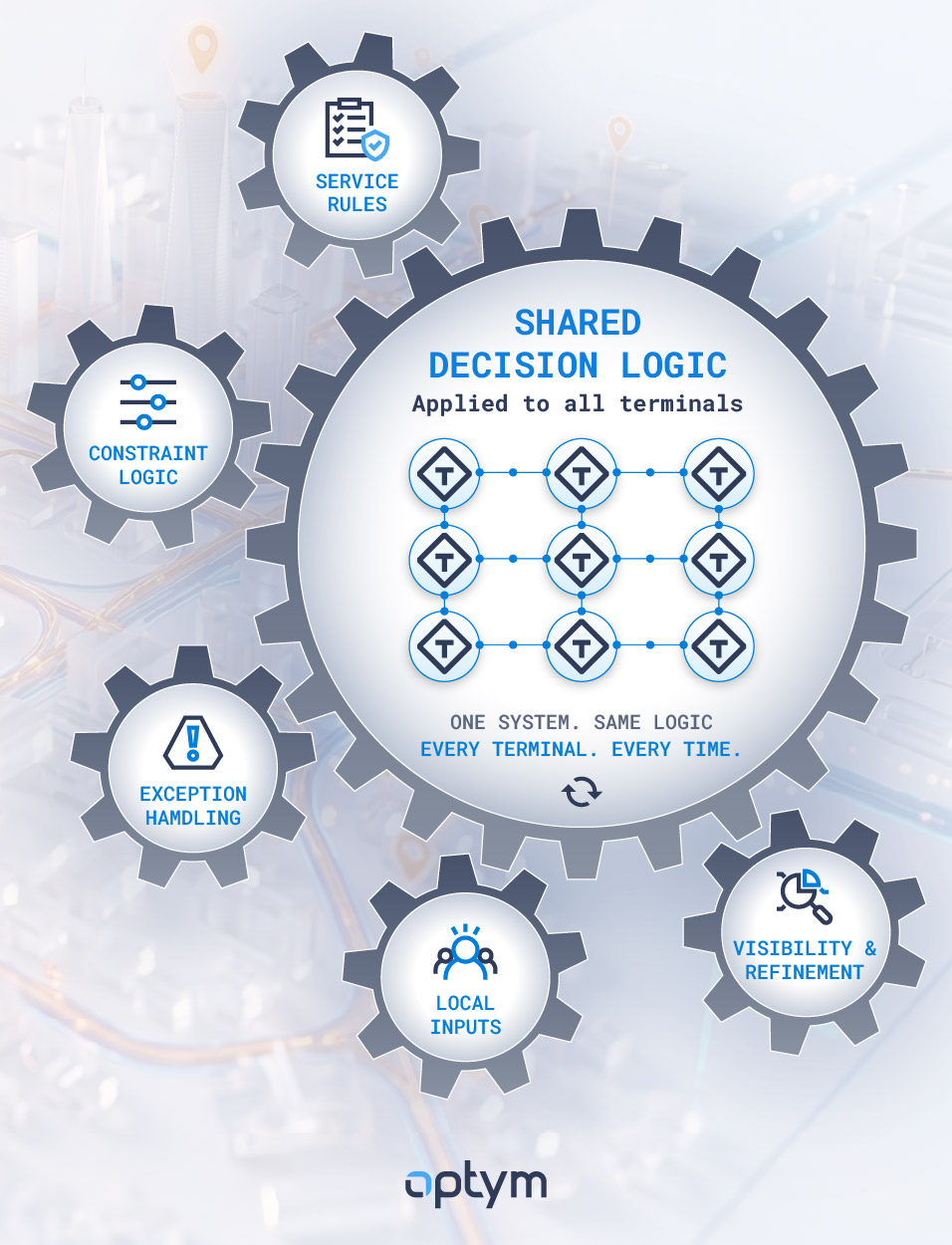
That depends on five things:
- Service rules — what must be true to deliver correctly
- Constraint logic — what makes a plan feasible in the field
- Exception handling — what should happen when conditions change
- Local inputs — what the market knows that the system must know
- Visibility and refinement — what leaders can measure, improve, and scale
All of this must be codified for decision-making.
Because mature networks do not build generic operating models. They translate local reality into shared decision logic.
That is how they scale.
Not by replacing human expertise. By turning it into a system that can make the best decisions consistently.
Key takeaway
In final mile, local knowledge will always matter. The question is whether it remains trapped in people or becomes part of how the network runs.
The best organizations do not standardize the people. They standardize the logic.
That is how great networks scale decision-making without losing what makes the operation work.