In final mile operations, a plan usually does not break because the route was sequenced poorly.
It breaks because the operation behind the route was simplified too much.
A map can show distance, stop count, and sequence. What it cannot show on its own are the conditions that determine whether the day can actually be executed: service requirements, labor rules, customer instructions, warehouse realities, and market-related friction.
This is the difference between a plan that looks efficient and one that can hold up in the field.
Within the final mile, optimization only works when those constraints are captured well enough to reflect how the day will actually run.
The simple way to think about it: The Constraint Balancing Scale
One missed input rarely looks serious on its own. But within the final mile, small constraint gaps compound quickly.
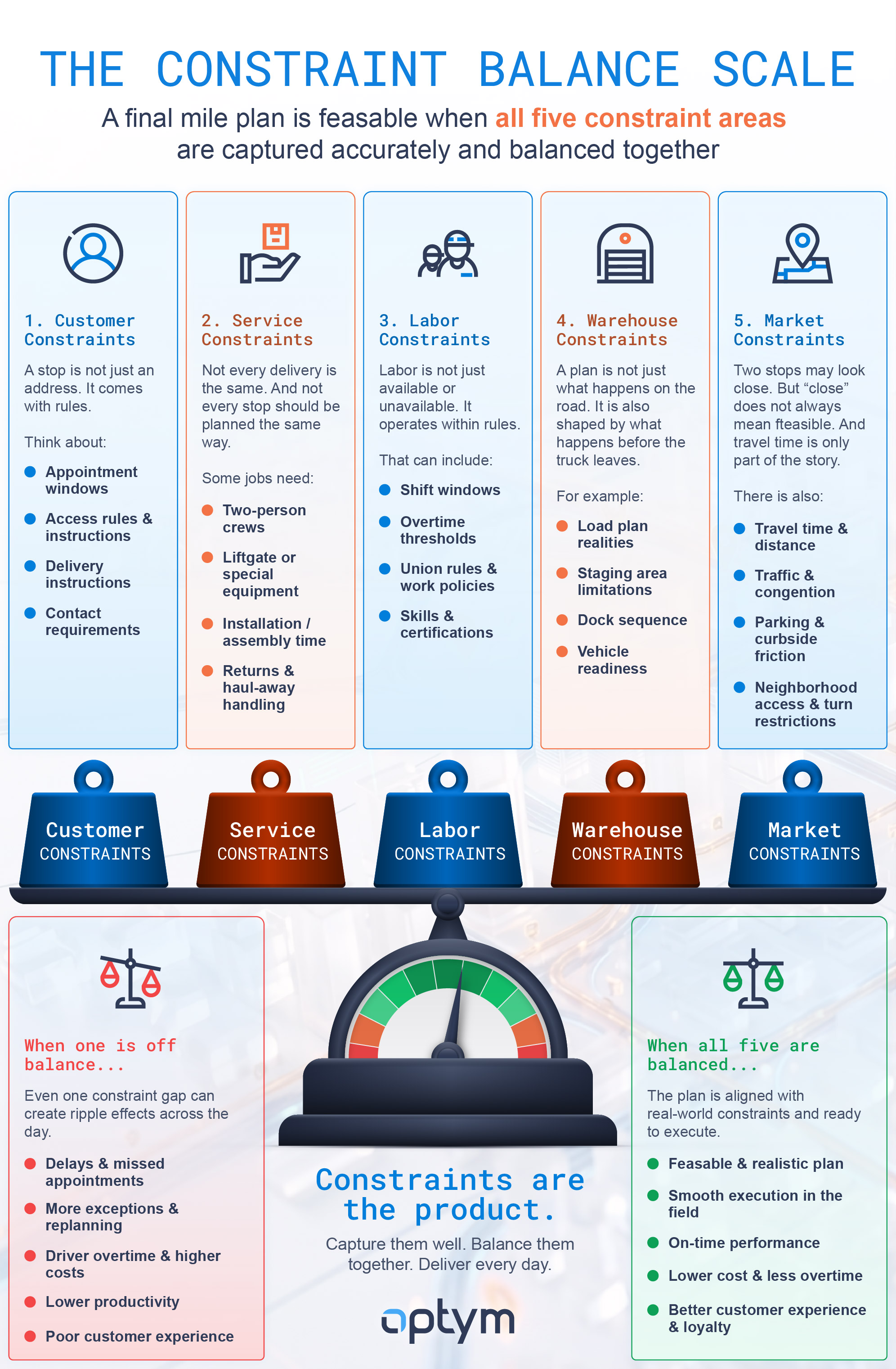
That is why feasibility depends on balancing five areas together: customer, service, labor, warehouse, and market.
The Constraint Balancing Scale is a simple way to visualize that idea. When all five are captured accurately and balanced together, the result is a plan that is far more likely to work in execution.
Why this matters
When constraints are captured well, planning improves in a very practical way.
Plans become more feasible. More repeatable. Easier to execute in the field.
That matters because most final mile instability does not begin on the road. It begins in planning, when operational realities are simplified, missed, or treated as exceptions instead of core inputs.
At scale, that creates a familiar pattern: dispatchers spend the day recovering from plans that looked efficient but were never fully executable.
The result is avoidable replanning, service inconsistency, and too much dependence on manual intervention.
The real advantage is not just better optimization. It is building plans that reflect how the operation actually runs.
Where common planning models start to break
This is exactly where many traditional planning approaches begin to struggle.
They work by simplifying the problem first. That makes planning easier, but it also strips out the very details that determine whether a route can hold up in execution.
Zone-based routing is a good example.
Zones help organize territory and can be useful as a starting point. But they are built mainly around geography, while final mile performance is shaped by much more than geography alone.
Inside the same zone, you may have a basic doorstep drop, a two-person room-of-choice delivery, a white glove install, a return pickup, and a stop with a narrow appointment window or difficult building access.
On a map, those stops belong together.
Operationally, they may have very little in common.
That is the problem. A zone can appear balanced geographically while being badly mismatched in service effort, labor fit, and time feasibility.
In mixed-day operations, that gap shows up quickly. Plans look stable early, then break once the day encounters the constraints the planning model did not fully account for.
The leadership takeaway
Final mile optimization is not about producing the cleanest route lines on a screen.
It is about operational clarity.
The strongest operators are not the ones who assume the network can be simplified. They are the ones who understand which constraints truly shape execution, capture them accurately, and turn them into plans the field can actually run.
Because in the final mile, constraints are not just part of the model. They are what make the model useful and able to impact the real world.