Arrow right

Beyond Routing: The Four Pillars of Final Mile Performance

For a long time, final mile was judged by one thing: the route.

  • How many miles did you save?
  • How tight was the sequence?
  • How many stops fit into the day?

That still matters. But it is not enough anymore.

Modern final mile operations deal with much more than route efficiency. These operations have to balance service windows, delivery types, crew needs, customer expectations, day-of disruptions, and constant tradeoffs.

That is why performance comes from more than a good route plan.

It comes from four connected pillars: planning, execution, experience, and decision-making.

Each pillar matters on its own. But the real impact comes from how they work together.

1. Planning: Build a day that can actually work
Planning is where the day starts. But planning is not just about finding the shortest route. It is about turning demand into a plan the team can actually execute. That means asking practical questions: - How long will each stop really take? - What kind of crew is needed? - Does the job need special equipment? - What delivery windows must be met? - Where do we need breathing room in the plan? A route can look efficient on paper and still fall apart in the field. Good planning is not just tight. It is realistic. The goal is simple: build a day that is workable from the start and strong enough to handle normal disruption.
2. Execution: Manage the day you actually get
No final mile day goes exactly as planned. - Customers are not home. - Items are missing. - Access is blocked. - Stops take longer than expected. - Traffic Builds. - A crew gets delayed. - A delivery needs to be rescheduled. This is not unusual. This is the job. That is why execution matters so much. Once the day starts, the operation has to respond to what is really happening, not what the morning plan assumed. That may mean: - Reassigning work - Adjusting routes protecting high-priority deliveries - Handling re-deliveries without throwing off the while day The challenge is not just reacting fast. It is reacting correctly while protecting service quality and staying compliant.
3. Experience: Deliver what people were promised
Final mile is one of the most visible parts of the supply chain because customers feel it directly. They remember whether: - Arrival widowow was reliable. - Communication was clear. - Delivery was completed properly And not every miss costs the same. A missed white glove appointment is not the same as a missed threshold delivery. The service promise matters, and so does the experience around it. But customer experience is only one part of the story. Planner and dispatcher experience matters too. Their tools need to be simple, fast, and easy to use under pressure, while also making it easier to onboard new planners as the operation scales. Driver experience is also essential. When the driver app is confusing or hard to use, it adds friction every day. In a high-turnover industry, intuitive driver tools help operations run more smoothly and support driver retention. Experience is not separate from operations. It is one of the clearest signs that the operation is working.
4. Decision-making: Optimize the system at scale
Every final mile operation makes tradeoffs. - Do you protect on-time performance or route stability? - Do you re-optimize now or avoid disrupting the rest of the day? - When does an issue stay local, and whend does it need escalation? These decisions shape performance every day. In many operations, the answers live in the heads of a few experienced dispatchers. That may work for a while, but it does not scale. Strong operations make these rules clear in advance: - When to replan - When to hold steady - What to prioritize - What should trigger action That creates consistency. It reduces reliance on heroics. And it helps performance stay steady across teams, sites, and markets.

The real point: these pillars are connected

These four pillars do not work in isolation.
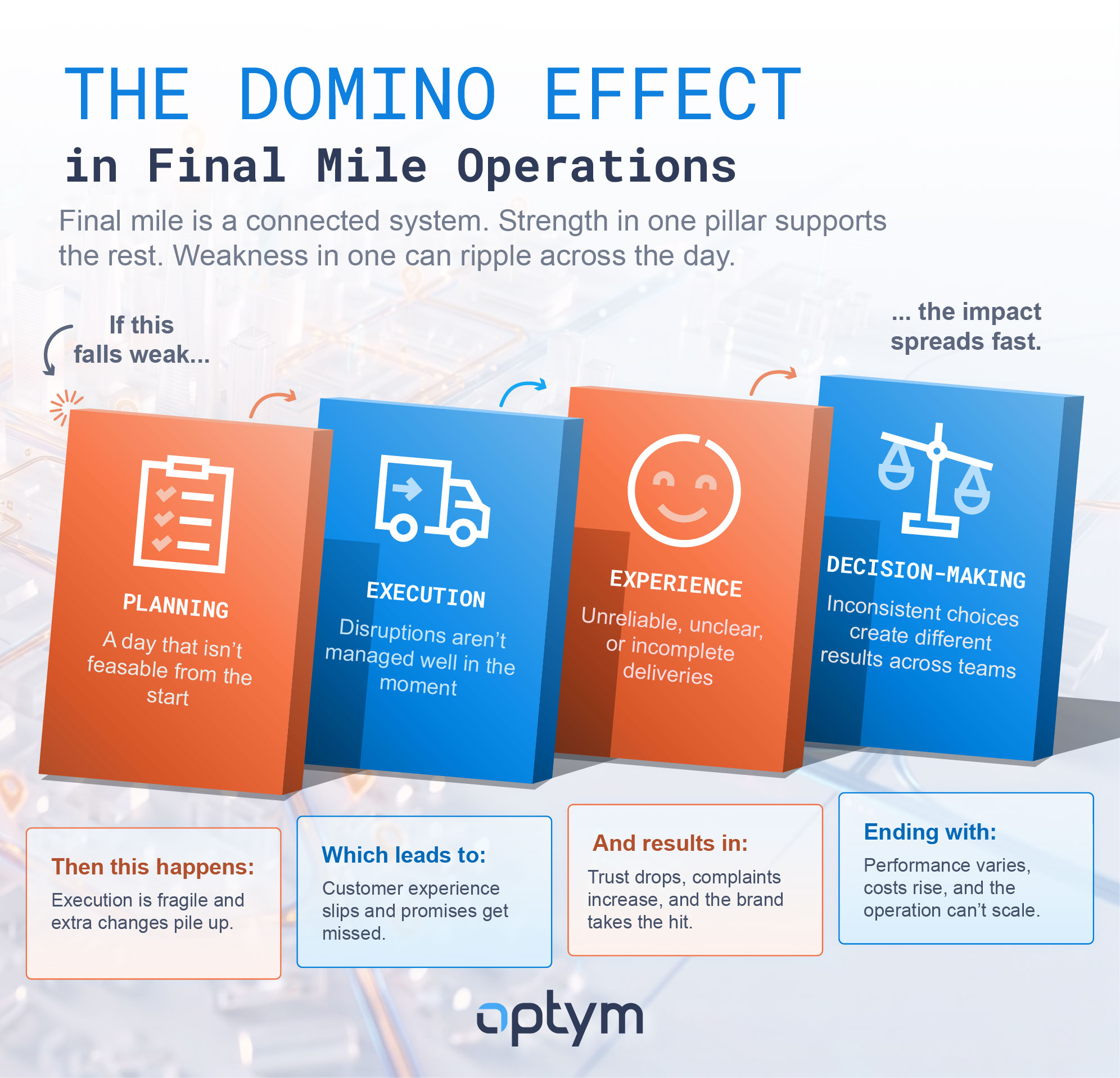
  • Better planning makes execution more resilient.
  • Better execution protects the customer experience.
  • Better decision-making helps the operation adapt as conditions change.

That is why final mile performance is not just a routing problem. It is an operating system problem.

The best final mile networks are not just building efficient routes. They are building operations that can plan realistically, adapt quickly, deliver consistently, and make good decisions at scale.


Want to stay current with Optym?

Sign up for our newsletter here.
You may opt out at any time. View our privacy policy.
Thanks for submitting the form.